Front Range Colorado · Head-to-Head
Fort Collins or Boulder for retirement?
Two Front Range Colorado college towns about 45 miles apart, with the same dry, sunny, four-season climate, the same 0.50% property tax rate, and the same $4,963 insurance estimate. Two cities rarely score this closely. The honest split: Boulder costs $403,000 more for the home, and this page is about what that premium buys.
The short version
Choose Fort Collins for the value: a typical home around $569,000 vs. Boulder's $972,000, roughly $403,000 less, with monthly budgets about $1,800 to $2,200 lighter, plus a slight edge on safety (8 vs. 7) and climate resilience (5 vs. 4). Choose Boulder for what the premium buys: walkability, 8 of 10 against 5, the widest gap on the board, driven by Pearl Street and a compact core; airport access (8 vs. 6, with Denver International about 45 minutes away against Fort Collins' 70); a deeper community-and-culture bench (9 vs. 8); and a perfect 10 for outdoor recreation against Fort Collins' very strong 9. Nearly everything else ties: healthcare at 7 of 10, active wellness at 8, an identical dry-and-sunny Front Range climate, the same 0.50% property tax rate, and the same $4,963 insurance estimate.
The scored comparison
Both cities scored the same way, on the same ten dimensions. The pattern here is unusual: they tie or nearly tie on almost everything, Fort Collins wins every cost row by a lot, and Boulder answers with walkability, access, and one extra point outdoors.
| Metric | Fort Collins COLORADO | Boulder COLORADO |
|---|---|---|
| Cost & money | ||
| Typical home value | $569,000 ✓ | $972,000 |
| Estimated retiree budget | $6,200–$7,800/mo ✓ | $8,000–$10,000/mo |
| Budget tier (1 = least expensive) | 3 of 5 ✓ | 4 of 5 |
| Property tax rate | 0.50% | 0.50% |
| Home insurance estimate | $4,963/yr | $4,963/yr |
| Our 10-dimension scores | ||
| D1 Airport access | 6/10 | 8/10 ✓ |
| D2 Budget | 5/10 ✓ | 3/10 |
| D3 Healthcare | 7/10 | 7/10 |
| D4 Climate resilience & insurance | 5/10 | 4/10 |
| D5 Tax friendliness | 7/10 | 7/10 |
| D6 Walkability | 5/10 | 8/10 ✓ |
| D7 Outdoor recreation | 9/10 | 10/10 |
| D8 Active wellness | 8/10 | 8/10 |
| D9 Safety | 8/10 | 7/10 |
| D10 Community & culture | 8/10 | 9/10 |
| Climate (nearly identical) | ||
| Winters | Real four-season, dry, sunny | Real four-season, dry, sunny |
| Summer heat severity (10 = worst) | 5/10, mild at altitude | 4/10, mild at altitude |
| Summer humidity (10 = worst) | 3/10, dry | 3/10, dry |
| Year-round mildness | 7/10 | 9/10 |
Scored 0–10 across every city on RetireMeHere; higher is better (except where noted). Checkmarks mark the stronger city in each row; ties and near-ties are left unmarked. Data: RetireMeHere city database, July 2026.
The five tradeoffs that actually decide it
1. Fort Collins wins on cost, and this time the gap is a chasm.
Fort Collins wins every cost row, and the margins are large. The typical home runs about $569,000 against Boulder's $972,000, roughly $403,000 or 41% less, and the estimated monthly retiree budget of $6,200 to $7,800 sits about $1,800 to $2,200 under Boulder's $8,000 to $10,000. Fort Collins also lands a budget tier lower (3 of 5 against 4) and scores 5 on budget against Boulder's 3. What makes this gap unusually clean is what the two cities share: Colorado's identical 0.50% effective property tax rate and the same $4,963 insurance estimate, so the entire difference sits in the purchase price, not the carrying costs. That is a $403,000 gap on the purchase price alone.
2. Boulder wins walkability by the widest margin on the board.
If the cost gap runs one way, the walkability gap runs the other, and it is nearly as wide. Boulder scores 8 of 10, Fort Collins 5, a 3-point spread that is the single largest anywhere on this scorecard. Boulder earns it with the Pearl Street pedestrian mall and a compact core where a real share of daily life, groceries, coffee, dinner, a doctor's appointment, is doable on foot. Fort Collins' Old Town is genuinely charming and walkable at its center, but more of the city is spread out and drive-everywhere. For a retiree who wants to lean on the car less, this is the clearest single thing Boulder's higher price buys.
3. Outdoors: a 10 against a 9, and both sit near the top of the scale.
Boulder earns one of the few perfect 10s we award for outdoor recreation, on the strength of the Flatirons, 45,000 acres of community-funded Open Space, and more than 300 miles of trail minutes from downtown. Fort Collins scores a 9, which is still elite: Rocky Mountain National Park about 45 minutes away, Horsetooth Reservoir on the western edge, and the Poudre Canyon for whitewater and hiking. The honest question is not whether Boulder's outdoor access is better, it is, by a hair, but whether that single point is worth $403,000 when Fort Collins already sits in the top tier. For most active retirees, both cities clear the bar with room to spare.
4. Access and cachet lean Boulder; safety and resilience lean Fort Collins.
The remaining gaps are a point apiece and roughly cancel. Boulder edges airport access 8 to 6, with Denver International about 45 minutes away against Fort Collins' 70, and community and culture 9 to 8, behind Pearl Street's scene and Boulder's AARP Top 100 recognition. Fort Collins answers with safety, 8 to 7, and climate resilience, 5 to 4. That resilience point is worth reading closely: Boulder carries the 2021 Marshall Fire, which destroyed more than 1,000 homes along its urban-wildland edge, while both cities share the Front Range's broader wildfire and hail exposure. Neither city is a clear winner here; it depends on whether you weight travel convenience and cultural buzz or a slightly calmer safety and risk profile.
5. On the things that anchor a retirement, they tie.
Strip away price, walkability, and that one outdoor point, and these two are remarkably matched. Healthcare ties at 7 of 10, with both cities inside the UCHealth system: Fort Collins anchored by UCHealth Poudre Valley Hospital, nationally ranked and among Colorado's best, and Boulder served by Boulder Community Health with Denver's major medical centers under an hour away. Active wellness ties at 8. The climate is effectively the same dry, sunny, four-season Front Range weather, roughly 300 sunny days a year in each. And the tax and insurance floors are identical: the same 0.50% property tax rate and the same $4,963 insurance estimate. Tax friendliness is identical at 7 of 10, which is what you would expect given that the state income tax and the property rate both cities pay are the same. The decision, in the end, is whether Boulder's walkability, access, and cultural edge are worth $403,000 more than Fort Collins.
Go deeper on each city
Full editorial profiles: neighborhoods, healthcare, a typical week, and the honest fit lists.
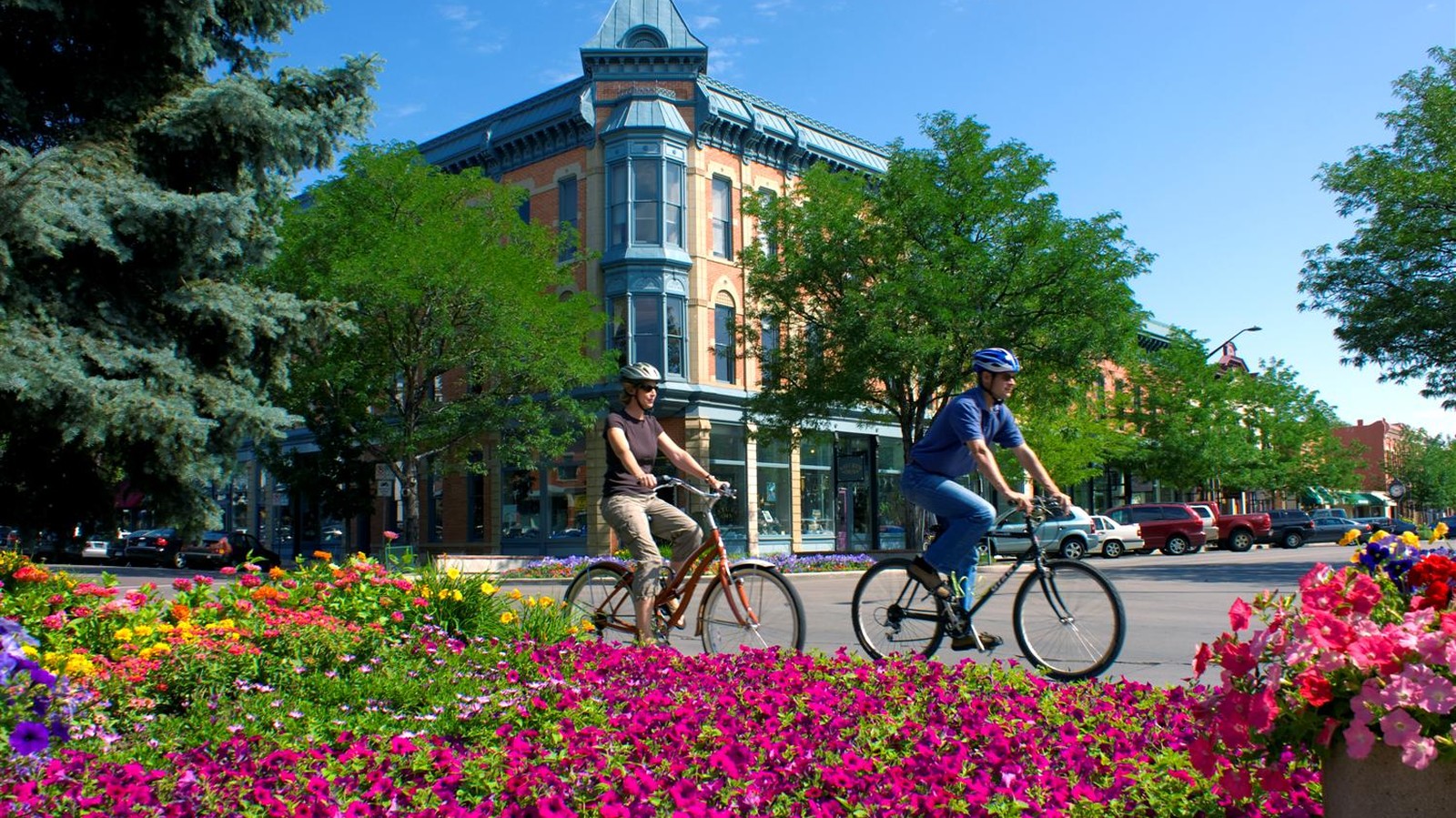
The value version of the Front Range outdoor retirement: Colorado State University energy, nationally ranked UCHealth Poudre Valley, Rocky Mountain National Park 45 minutes out, and a home price roughly $403,000 under Boulder's.
Read the Fort Collins profile →
The premium version of the same idea: a perfect 10 for outdoor recreation, the Flatirons and 45,000 acres of Open Space, the Pearl Street mall, AARP Top 100 recognition, and the price and Marshall Fire ledger told straight.
Read the Boulder profile →Fort Collins vs. Boulder for retirees: the questions people actually ask
Is Fort Collins or Boulder better for retirement?
These two Front Range Colorado college towns are close to twins, so the decision comes down mostly to price. Fort Collins is far cheaper: a typical home around $569,000 against Boulder's $972,000, roughly $403,000 less, with monthly budgets about $1,800 to $2,200 lighter. Boulder answers with walkability (8 of 10 vs. 5, the widest gap on the board), airport access (8 vs. 6), a deeper community and culture bench (9 vs. 8), and a perfect 10 for outdoor recreation against Fort Collins' 9. Healthcare ties at 7 of 10, active wellness ties at 8, both share Colorado's 0.50% property tax rate and an identical $4,963 insurance estimate, and the climate is effectively the same. Fort Collins edges safety (8 vs. 7) and climate resilience (5 vs. 4).
Is Fort Collins cheaper than Boulder?
Yes, substantially. Fort Collins' typical home runs about $569,000 against Boulder's $972,000, roughly $403,000 or 41% less, and its estimated monthly retiree budget of $6,200 to $7,800 sits about $1,800 to $2,200 under Boulder's $8,000 to $10,000. Fort Collins lands one budget tier lower (3 of 5 vs. 4) and scores 5 of 10 on budget against Boulder's 3. Because both cities share Colorado's 0.50% property tax rate and the same $4,963 insurance estimate, the entire cost gap sits in the purchase price and what flows from it, not in the carrying costs.
Is Boulder more walkable than Fort Collins?
Yes, and it is the widest single gap on the scorecard. Boulder scores 8 of 10 for walkability against Fort Collins' 5, a 3-point spread driven by the Pearl Street pedestrian mall and a compact core where more of daily life is doable on foot. Fort Collins' Old Town is genuinely charming and walkable at its center, but more of the city is drive-everywhere. For a retiree who wants to give up a car, or at least use it less, this is the clearest thing Boulder's premium buys.
Is healthcare better in Fort Collins or Boulder?
It is a tie at 7 of 10. Both cities sit inside the UCHealth system: Fort Collins is anchored by UCHealth Poudre Valley Hospital, nationally ranked and among the top hospitals in Colorado, and Boulder is served by Boulder Community Health and nearby UCHealth facilities, with Denver's major medical centers under an hour away for both. Neither city should be decided on hospital access alone; the scores say they are even.
Do Fort Collins and Boulder have the same climate and taxes?
Effectively yes on climate and identically on the property-tax and insurance floors. Both are dry, sunny, four-season Front Range cities about 45 miles apart, each with roughly 300 sunny days a year, so their climate scores are nearly identical. Both share Colorado's 0.50% effective property tax rate and the same $4,963 home insurance estimate. Tax friendliness is a tie at 7 of 10. Both cities pay Colorado's flat 4.4% income tax, both get the state's post-65 Social Security exemption and its $24,000 retirement-income deduction, and both sit on the same 0.50% property rate. There is no tax reason to prefer one over the other.
More city matchups
Still deciding?